We're not here to guess

What Seafoam is
Seafoam is a small, senior team that operates as the marketing department for mid-market companies that don’t have one, or that have one and know it isn’t doing what it should be doing.
We function as three things at once: the strategic head (CMO), the measurement engine (RevOps), and the execution arm. Three functions, one team, one number every month. The shape of the firm exists because the work, done well, actually requires all three. Most companies in our category buy one or two and skip the third. We don’t.

Your team
Nikki Bisel
Founder & CEO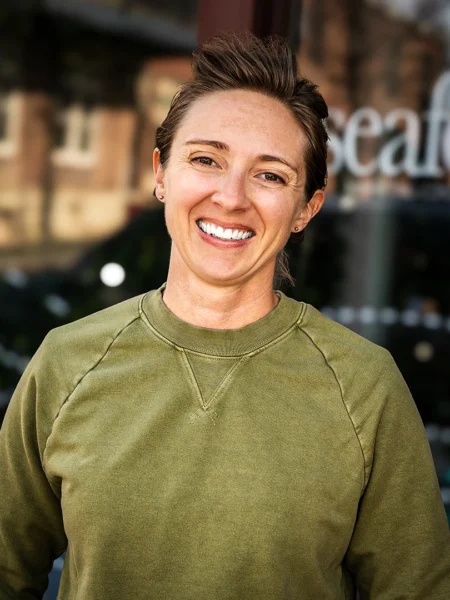

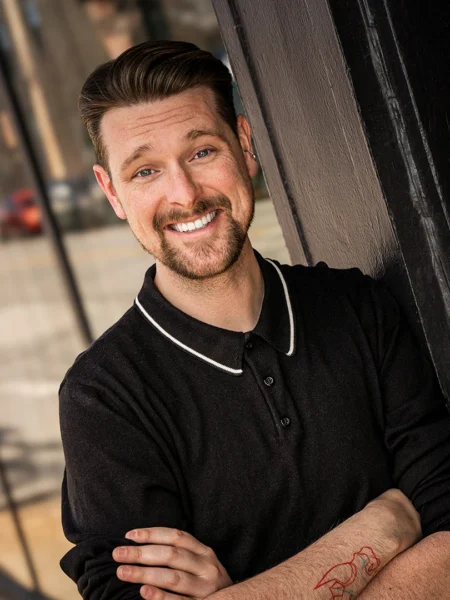



Allie Wolf
Digital Marketing Strategist



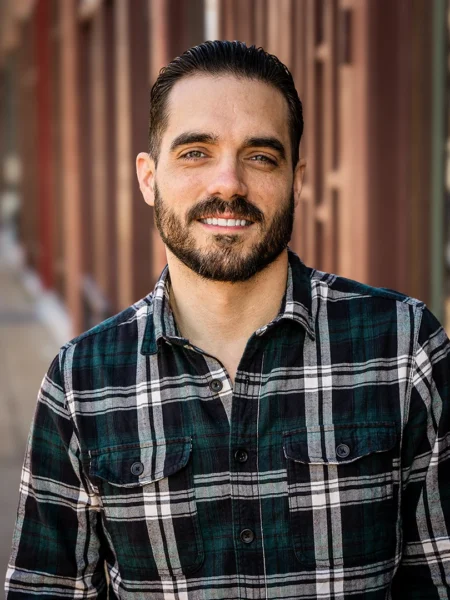

Nikki Bisel
Nikki owns the thing Seafoam is built to prove: that marketing is supposed to grow a business, not just keep it busy. The method, the standards, the measure of what’s good enough to ship. If the work isn’t working, that’s on her.
She has more than twenty years in the discipline. The foundational lesson came earlier, in a high school job at a golf course, working for a manager who used slow days differently than most people do. Not to coast, but to do the behind-the-scenes work nobody would ever see. Prepping for the busy stretch before it hit. Getting ahead of the thing that would otherwise catch you off guard. It sounds simple. Most people don’t actually do it.
She carried that instinct into freelance design in her early twenties, where it took on a second shape: when you freelance, the sale, the delivery, the client being happy, and the project actually working aren’t four separate jobs. They’re one. The second you start treating them as separate, you’ve already started losing the client. You just don’t know it yet. Seafoam was built from what she learned doing that.
Her conviction about the discipline is the kind that makes comfortable people uncomfortable: you don’t move the number by staring at it. Outcomes are what happen when the inputs are good. Most of the industry sells traffic, leads, and rankings, and those matter, they’re how you keep score, but nobody wins by watching the scoreboard. She’d rather fix the swing.
The same instinct runs through how she thinks about data. Most companies don’t have a measurement problem. They have a decision problem, and the dashboard is where they go to avoid making it. Add another metric, run another report, feel productive without ever saying out loud: this is the one thing that matters and these others don’t. What she reaches for instead is the opposite, find where the revenue is actually leaking, pick the one thing, and decide. Most growth isn’t hiding in more data. It’s hiding behind a decision nobody wants to make.
Outside of work, she doesn’t carry a phone. No GPS. No screen time at the dinner table. She’s fully in during working hours, screens are a large part of the job, but when she’s home, she’s home. She’ll tell you it’s not a philosophy, just a preference. But it’s also exactly consistent with everything else about how she builds: intentionally, without noise, and for the long run.


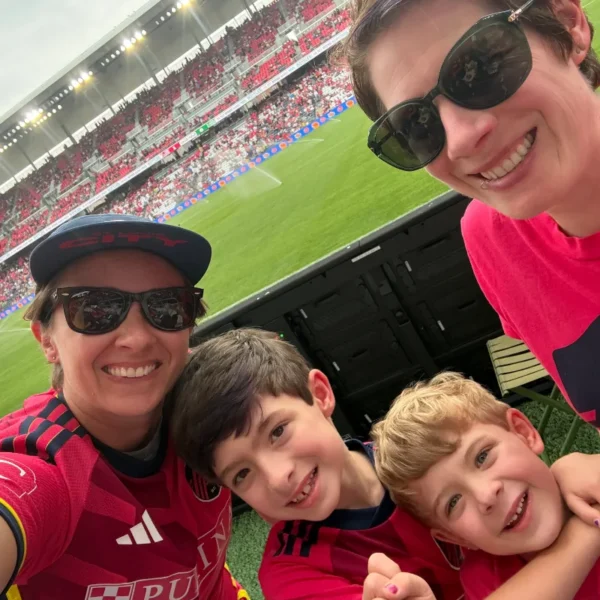
Ryan Foizey
Ryan works with business owners to find where growth has stalled, not tactically, but structurally. His job is to get inside the gap between what a company’s brand is promising and what its best clients are actually experiencing, then build the path to close it. He doesn’t arrive with a solution. He arrives with the right questions.
He brings more than fifteen years of agency and marketing experience to that work, across media, SEO, paid strategy, email, brand, and full-funnel strategy for companies ranging from early-stage to well past $100M in revenue. That breadth wasn’t by design; it’s what happens when you stay curious and keep saying yes to the hard problems. He ended up with hands-on fluency across every channel and service that makes up a full marketing operation, which is exactly what makes him effective at diagnosing the ones that aren’t working.
At Seafoam, that experience gets pointed at one thing: finding where the revenue is actually leaking and building the system to stop it. His conviction about the discipline is specific and unpopular: most marketing fails not because of execution, but because of a refusal to think critically about what actually belongs in the mix. Being visible in more channels is not the same as being effective in any of them. Every decision, from brand positioning to a negative keyword list, has a downstream effect on every other part of the business. If those decisions aren’t connected to each other, that’s a large part of the problem.
Before the agency years, he was a working creative: multi-instrumentalist, singer, and live theatre director and producer with more than thirty professional productions in St. Louis. He built and marketed his own company, Theatre Lab, before he ever worked inside someone else’s. That creative foundation, combined with fifteen-plus years of strategy and execution across nearly every industry the discipline touches, is the lens he brings to every engagement.



Jason Kanzler
Jason owns the user experience across every Seafoam website, the bridge between what a business needs to accomplish and what its audience actually needs to find. His job is to make sure those two things aren’t working against each other.
Twenty years in, he’s held nearly every creative title the discipline offers, Interactive Designer, Senior Designer, and now Creative Director, and the through-line across all of it is the same instinct he’s had since the beginning: figure out what actually matters, and let the rest fall away. He came up the non-traditional way. Before his first agency role, he co-opened a bar in the Grove, ran the kitchen, took on all the design work, and became the resident DJ. Working 60-hour weeks in a fast-paced environment and loving it. That stretch of his life kicked off a DJ career that ran for about 20 years, and it taught him something he still applies directly to client work: when you’re doing too many things at once, you get very good at figuring out what actually matters.
His first agency role confirmed it. He came in to make social media graphics and stayed to absorb everything, design, development, the business behind it. Two decades in, he’s still learning. His framework for the work is direct: if you can understand why something is being done, you should be able to explain how it’s being done. That principle governs every brief, and it’s also why he invests so heavily in the people around him. The rising tide lifts all boats, and he backs it up by teaching colleagues and peers everything he can.
The projects that bring out his best work are the ones that genuinely need help: real problems, solutions that require thought, outcomes that make a noticeable difference in how the client actually does business. Ask him what’s playing right now and he’ll tell you, there’s always a song.


Allie Wolf
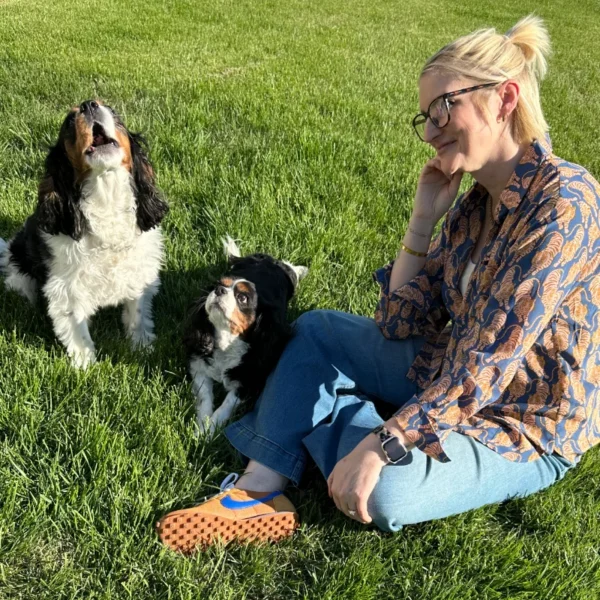
Allie owns the words and the spend, the content that earns a client’s audience and the advertising that puts the work in front of them. Website copy, blogs, case studies, email, social, SEO, paid campaigns: if it’s written or placed on behalf of a Seafoam client, it’s hers.
She came up fast. Eight years into a marketing career with five of them at Seafoam, she built her foundation in-house at a credit union where a three-person team meant there was no such thing as staying in your lane. Social, ads, email, she learned by doing all of it, often at the same time. What that environment gave her wasn’t just range. It gave her an instinct for how different people need to be reached differently, an instinct she now applies every time she sits down to build messaging or position content for a new audience.
Her conviction about the discipline is one the industry hasn’t fully caught up to: good SEO and good writing aren’t in tension. They’re the same thing. SEO done right is just the discipline of answering people’s questions better, more specifically, more honestly, more usefully than the next result. When that’s the frame, the checklist disappears and the work gets better.
The clients who bring out her best are the ones who believe in what they do. Enthusiasm is contagious in this work, when a client is genuinely excited about their product or their customers, it shows up in the content. That energy is something you can build a campaign around.
Early in her time at Seafoam, a client pulled her aside to say they’d noticed a shift in the quality of their content since she’d taken it over. It’s the kind of feedback that’s easy to brush past, but she didn’t, because it named exactly what she’s trying to do. Not produce content. Change what the content does.



Cenna Mawhinney
Cenna owns the visual identity of every brand Seafoam touches, from the first logo sketch to a fully launched website. Her design philosophy starts from a conviction the industry doesn’t love: constraints are a starting point, not a destination. The work that actually moves people almost always came from someone who understood the rules well enough to know which one was worth bending.
In eight years of professional design work, she’s held lead designer positions on some of the highest-visibility projects her discipline produces. The clearest example is Music at the Intersection, a city-wide campaign built to spotlight underground St. Louis artists and use music to bridge communities. As lead designer, she was responsible for the full visual system, festival posters that ran on billboards and inside stadiums, stage banners for Erykah Badu and Herbie Hancock performances, limited-edition merch, signage, and a festival app used throughout the event. It was the first time she thought at real scale, where one visual decision ripples across dozens of touchpoints. That project taught her something she hasn’t forgotten: design is more than appearance. It’s the environment you create and the feeling people carry home with them.
Her favorite clients are the ones with something at stake. Local businesses and nonprofits who aren’t just looking for a new logo or a fresh website. They’re trying to build something their community can rally around. That’s the work she was made for.
Outside of client work, she makes ceramics by hand, runs her own brand, and shows up at farmers markets and art shows across St. Louis. Running a passion business taught her the most important thing about being a designer: the people who hire you aren’t just buying a service. They’re trusting you with something they love.



Jared Lender
Jared owns the moment a client’s strategy moves from concept to committed, and everything it takes to keep that momentum through delivery. He sits at the intersection of strategy and execution, which means he’s accountable for both the thinking and the result. His job is making sure nothing important falls through the gap between those two things.
Over fifteen years, he’s worked both in-house and agency side, across more than 200 client relationships as an account manager, strategist, and marketing manager. That dual exposure changed how he thinks about accountability: in-house, you live with the consequences of every decision; agency-side, you have to earn the right to make them. He’s watched businesses fail. He’s watched others grow faster than they were ready for. Both taught him more than any success did. What he carries from all of it is a practical, pattern-based understanding of what actually moves businesses forward, and what just looks like it does.
A student of jiu-jitsu, he treats strategy the same way: something you study, practice, get beaten by, and refine over time. Most practitioners treat strategy like an opinion, something you arrive at through intuition and defend through confidence. He thinks that’s how you stay mediocre. The people he respects most are the ones who are still learning, still questioning, and still willing to be wrong.
The most useful thing he’s found in fifteen years of client work isn’t a framework. It’s the discipline of listening to understand rather than listening to respond. The client almost always knows more about their problem than they’ve been given credit for. His job is to help them articulate it, not to arrive with the answer already written. The best work he’s ever done came from asking the question nobody else had thought to frame.



When you hire Seafoam, you hire the people on this page
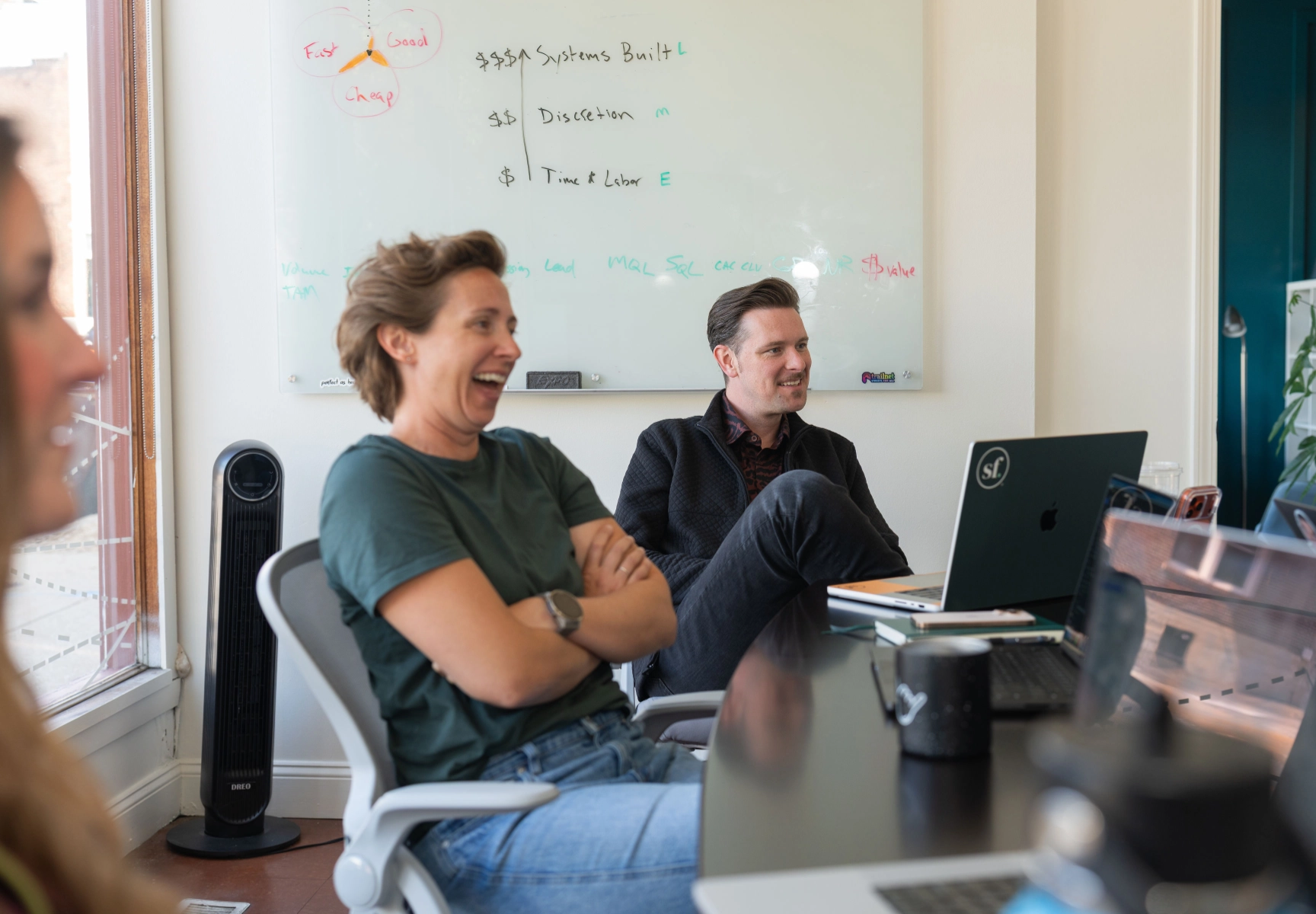
No account managers. No handoffs. The person you meet in the Strategic Alignment Interview is the same person who’s at the annual strategic reset.
This sentence matters more than anything else on the page. Most of the leaders we talk to have been pitched by someone who vanished after signing. They got handed off to a coordinator, then to a junior, then to whoever happened to be free that quarter. By the time they realized what had happened, they were two years and six figures into a relationship that wasn’t the one they signed up for.
That doesn’t happen at Seafoam. The team is small enough that it can’t. The senior people who close the engagement are the senior people who run it, every month, for as long as you’re working with us.
Thinking
Latest Seafoam News
New people, recognition, and milestones, posted when something material happens.
Seafoam started as a marketing agency.
For a long time, we were a good one. Established companies hired us to grow revenue and, by every honest measure, we did. We built campaigns that converted, content that ranked, websites that produced pipeline, ad accounts that brought in real customers at sane CAC. Our clients grew because we’re good at the work in front of us.
But we kept hitting the same ceiling, on engagement after engagement. We were paid to run a slice of the marketing operation, and the slice we owned was almost never the part of the business actually limiting growth. The strategy that should have been pointed at revenue was being set without our input. The measurement system that would have told us what was actually working didn’t exist. The conversations about which customers were worth chasing were happening in rooms we weren’t invited to. We could see the bigger lift sitting right next to the work we were doing, and we couldn’t reach it from the agency seat.
So we changed the firm. Different scope, different rhythm, different accountability. Same craft, deeper. We diagnose first now. We build the measurement layer underneath. We sit in the strategy conversations from the beginning, and we own the number we move every month. The agency we used to be was good at producing results inside a frame somebody else had drawn. The firm we are now produces results because we draw the frame.
What we believe
- Marketing should answer to revenue. In dollars. Every month. The same way every other line item in your business does.
- The most profitable thing you can do is make the right customers’ entire experience with you compound over time. Acquisition gets the attention. Retention and expansion are where the money is. The customer who came in clean and stays for years is worth more than three who came in fast and left after one purchase, and most companies don’t price their marketing decisions accordingly.
- Most marketing failures are diagnosis failures. Treating symptoms instead of causes is why most mid-market companies have been paying for marketing that doesn’t move the business for years.
- Fine is dangerous: The biggest risk to an established company isn’t failure, it’s adequacy. The plateau that nobody names is the one that compounds against you.
- Execution is being commoditized. Judgment is not: AI, off-the-shelf tooling, and global execution capacity are eating what marketing agencies used to sell. What’s left worth paying for is clarity, judgment, and accountability.
- The team that diagnoses is the team that executes. Handoffs are where good work goes to die. We don’t do them.