
Most service pages are written for the person who built the product, not the person who needs to buy it.
They list capabilities. They describe processes. They explain how the service works. And then they stop — right at the moment when the reader most needs to feel something.
This isn’t laziness. It’s a structural problem. Most copywriters default to what’s concrete and defensible: the features, the deliverables, the process steps. The emotional and strategic meaning of the work is harder to articulate, so it gets left out — and the reader is left to make those connections alone.
They usually don’t.
The gap between what you sell and what buyers actually buy
There’s a framework we use at Seafoam called the Benefits Ladder. The concept isn’t new, but its application to B2B service copy is underused to the point of being almost invisible.
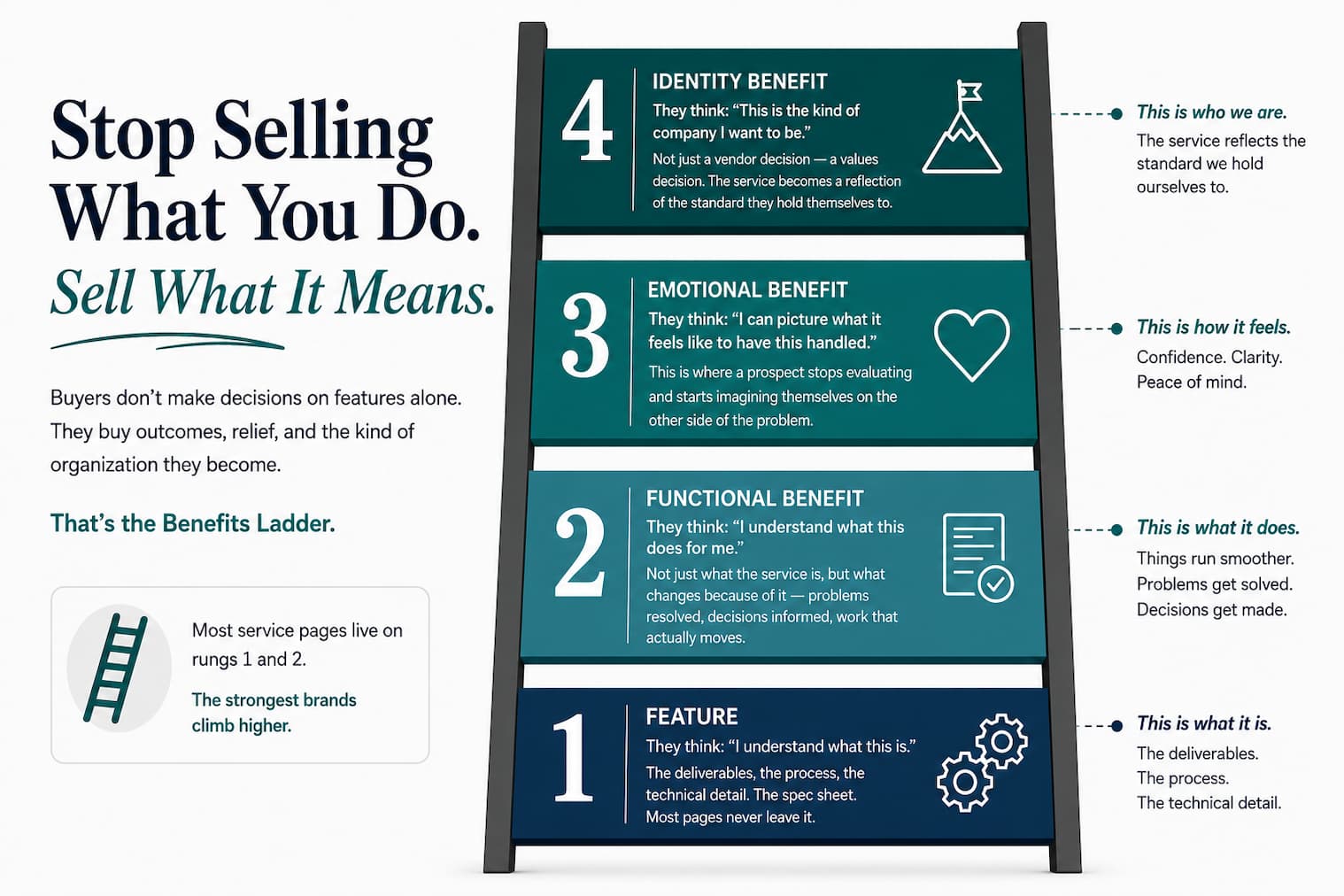
The ladder has four rungs:
Rung 1 — Feature. Your prospect reads the page and thinks: “I understand what this is.” The deliverables, the process, the technical detail. The spec sheet. Most pages never leave it.
Rung 2 — Functional Benefit. They think: “I understand what this does for me.” Not just what the service is, but what changes because of it — problems resolved, decisions informed, work that actually moves.
Rung 3 — Emotional Benefit. They think: “I can picture what it feels like to have this handled.” This is where a prospect stops evaluating and starts imagining themselves on the other side of the problem.
Rung 4 — Identity Benefit. They think: “This is the kind of company or person I want to be.” Not just a vendor decision — a values decision. The service or product becomes a reflection of the standard they hold themselves to.
Most B2B service copy lives on rungs one and two. It’s accurate. It’s technically competent. And it completely misses why people actually make buying decisions.
Why this matters when the stakes are real
If you’re running a company at scale, you’ve already solved for competence. You don’t need another vendor to explain what they do. You need to know whether they understand what’s at stake for you.
The gap between a fine business and a great one usually isn’t a missing tactic. It’s a misalignment between what the company promises and what customers actually experience. It’s a marketing function that can produce activity but can’t demonstrate its relationship to revenue. It’s a leadership team that’s too deep in the machinery to think clearly about the company’s position.
Those aren’t feature problems. They’re identity problems.
And a service page that only sells features will never reach a buyer who’s operating at that level. They’ll read it, nod, and move on — because nothing in it spoke to the actual weight of the decision they’re carrying.
What ladder-aligned copy actually looks like
It’s not about making copy more emotional in the sense of warmer or softer. The identity and emotional rungs, done well, are precise and serious. They name the real stakes clearly.
The difference is in where the copy spends its time.
A features-first page spends most of its real estate describing the service. A ladder-aligned page spends most of its real estate describing the reader — the situation they’re in, the thing they’re trying to resolve, and who they want to be on the other side of it. The service description is still there. It just earns its place instead of leading.
The structure that works:
- Open at the identity and emotional level. The reader should feel understood before they feel educated. If the first thing your page does is explain your process, you’ve already lost the reader who needed to feel seen.
- Establish capabilities in the middle. Once someone is emotionally oriented, technical depth builds credibility. It doesn’t overwhelm. The same information lands differently depending on where it appears.
- Bridge capability to consequence. There’s a section most pages skip entirely: the one that connects what the service does to what it actually means for the business. The reader’s real concern usually isn’t a technical gap — it’s a human stress that has business consequences. Name it.
- Peak at outcomes. If your outcomes section reads like a continuation of capabilities — listing what the service does rather than what it means — it’s been written at the wrong rung. This is where the page should leave the reader with something to carry.
- Close relationally. A call to action that acknowledges where the reader is and invites a conversation will always outperform one that directs a transaction.
The question worth asking
When was the last time you read your own website the way a prospective client would?
Not to check for accuracy. Not to catch typos. But to ask: Does a prospect read this and feel understood — or do they just feel informed?
If your service pages are technically correct but leave a capable, skeptical buyer unmoved — the problem probably isn’t the service. It’s the rung.